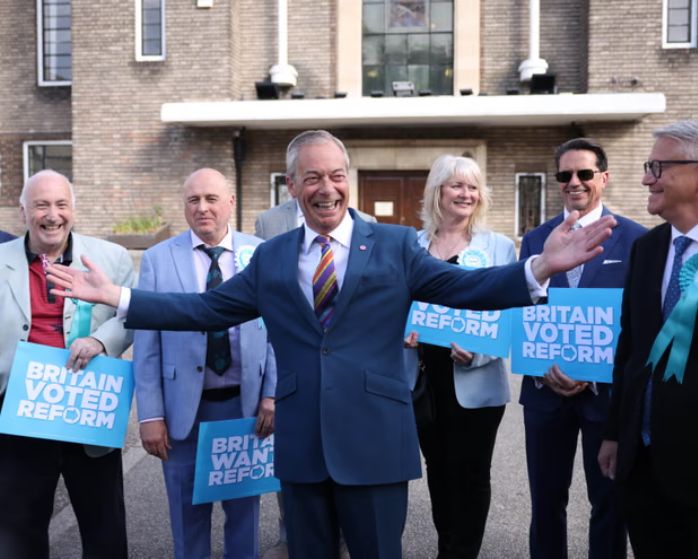
The local election results delivered by Reform UK are more than just a strong night for one party. They may represent one of the clearest warnings yet that British politics is entering a period of realignment, volatility and growing public dissatisfaction with the traditional two-party system.
Across parts of England, Reform converted frustration into votes at a scale few expected, even leader Nigel Farage himself. While local elections can often produce protest voting and unusual outcomes, the breadth of Reform's gains suggests something deeper than a temporary backlash. The message from many voters appears direct, in that they no longer feel represented by the political establishment and are prepared to take risks on alternative options. That does not necessarily mean voters fully endorse every Reform policy or have deep loyalty to the party itself. In many cases, it simply reflects an emotional backlash against the status quo.
Frustration as political fuel
British politics has endured years of turbulence. Brexit divisions, leadership instability, economic pressure, declining trust in institutions, stretched public services and a sense among many communities that little materially improves regardless of which major party wins power. And don't forget immigration. Reform has successfully positioned itself as the outlet for that frustration.
There is an important distinction, however, between being an effective vehicle for anger and being capable of leading effectively. Protest movements often thrive because they can simplify problems and channel public emotion into clear narratives. Governing is considerably harder. Expectations can quickly outpace reality once a party moves from opposition to responsibility.
That may become one of the defining tests for Reform in the years ahead. Some voters may be projecting onto the party a belief that it can rapidly "fix" politics, immigration, public services or economic decline. British democracy has repeatedly shown that change in government does not automatically produce fast solutions, particularly within a constrained economic environment and highly centralised state system. Something different is not always something better.
Two-party politics under pressure
Still, dismissing Reform's rise as merely a protest would risk missing the wider democratic significance of what has happened. The results point towards a weakening of the traditional two-party system that dominated British politics for much of the twentieth century. For decades, power largely alternated between Labour Party and Conservative Party, even when smaller parties enjoyed moments of regional or temporary success.
That model now appears under sustained pressure, not least because Nigel Farage, for so long a mocked figure on the fringes of politics, found a way to give a silent majority a place to coalesce around a new party, with a genuine chance of taking control rather than a mere protest vote.
The Conservatives face a difficult existential question. Reform's rise suggests a meaningful section of right-leaning voters no longer trusts the Conservative Party to deliver on key issues, particularly around immigration, borders, taxation and national identity. Meanwhile, Labour's challenge may be different but equally complicated: how to maintain a broad coalition in an era where political loyalties are becoming weaker, more fragmented and more emotionally driven. Their losses were very heavy, putting into question not just the Prime Minister's position, but where Labour fits into politics at a time when voters, at least this week, selected the Lib Dems and Greens as a centre-left voting destination.
Populism and democratic response
The rise of populist sentiment is also central to understanding these results. Populism is often misunderstood simply as anger or extremism. In reality, populism usually grows when large numbers of people believe political institutions no longer listen to them or reflect their concerns. Reform's messaging has consistently drawn on this sentiment, framing politics as a divide between ordinary people and an out-of-touch establishment. As we knew before these results, that message has become politically powerful not only in Britain, but across much of the Western world.
There are democratic positives and democratic risks within that trend. On one hand, these results demonstrate democracy functioning exactly as it is supposed to. The higher voter turnout lends weight to this view. Voters who feel ignored used the ballot box to send a message. No political party is entitled to support indefinitely. If people are dissatisfied, democratic systems allow them to seek alternatives. In that sense, Reform's success can be viewed as evidence of democratic responsiveness rather than democratic failure. If you get the numbers, you win. That is democracy playing out in real time.
Yet there are also longer-term questions about what happens when politics becomes increasingly fuelled by frustration, distrust and anti-establishment sentiment. Democracies require more than electoral victories. They also depend on institutional trust, compromise, realistic public expectations and acceptance that complex problems rarely have immediate solutions.
Volatility or realignment?
At the same time, the election results should not automatically be interpreted as evidence of a permanent political transformation. British politics has a history of dramatic electoral moments that later fade or evolve. Parties that rise rapidly can struggle to maintain discipline, broaden appeal or transition from outsider movements into credible governing forces.
The next few years will determine whether Reform becomes a lasting structural force in British politics or whether it represents a moment of democratic protest driven by public exhaustion. One, in my opinion credible, theory is that they will continue to position themselves as the opposition to national government, enabling a continuation of their "anti-establishment" voice that clearly held so much appeal to voters. This is despite being in control of many councils now, holding decision-making power.
What comes next
Either way, the local elections reveal something important about the national mood. Many voters appear impatient, distrustful and increasingly willing to break old political habits. That has profound implications not only for parties, but for how democracy itself functions in modern Britain.
The old assumptions of British politics are weakening. Voter loyalty is softer. The era of relatively predictable two-party dominance may be entering a more unstable and fragmented phase.
Whether that ultimately strengthens democracy through greater competition and accountability, or weakens it through deeper polarisation and instability, remains to be seen.
Member discussion
Comments
No comments yet.
Log in or register to comment on this article.