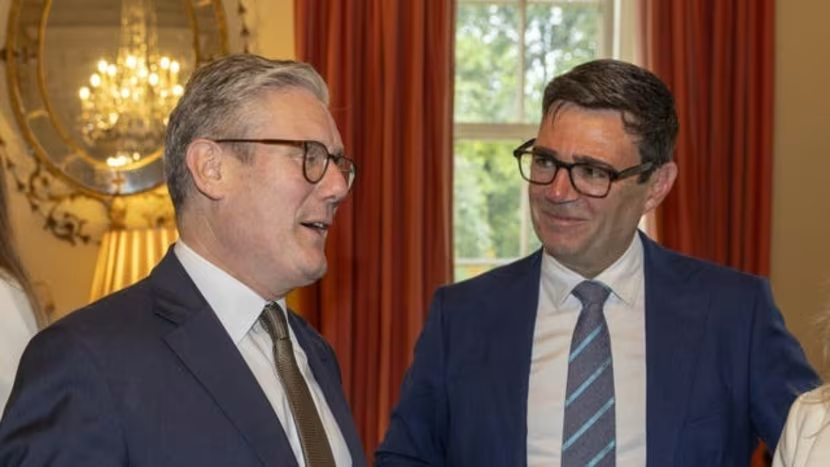
Labour's Leadership Problem Is Bigger Than One Man.
The turbulence of Keir Starmer's leadership reflects a deep problem within the Labour Party. This is not a question of whether Starmer survives politically, it is about the future, or perhaps remainder, of Labour's government and how they react to the rise of Reform.
Pressure on the Prime Minister could not be higher. 80 Labour MPs have gone public in asking Starmer to set a timetable for setting aside so a new leader, and thus Prime Minister, can be found and repair the serious political damage Labour has been suffering over recent months.
Readers should note there is a huge difference between 80 Labour MPs agreeing that Starmer should "move on" and those same MPs agreeing on who should replace him and backing that alternative.
Broad unrest, fragmented purpose
At present, Labour's anti-Starmer sentiment appears broad but fragmented. Some MPs believe the government lacks ambition. Others fear Labour is becoming disconnected from voters over immigration, public services and living costs. Others never backed Starmer from the start.
Some simply worry about the rise of Reform UK and deteriorating polling in seats once considered comfortably safe. The assumption that many constituencies were politically secure no longer feels reliable. Reform UK's growing support has unsettled many MPs who are hearing frustration and distrust on the doorstep and, for the first time in their political career, face the prospect of being kicked out of parliament.
With Labour holding 403 MPs, losing support of around 80 colleagues is politically bruising but still manageable. It creates instability, poor headlines and speculation about leadership, but it does not automatically produce a viable coup. Many MPs remain deeply cautious about destabilising a government only two years into office, which is evidenced by the 100 Labour MPs who today came out in support of the beleaguered Starmer.
There is also caution about openly calling for Starmer to resign. In Westminster politics, anyone "breaking cover" to tell a leader to go must be confident the leader will eventually be forced out. Otherwise, they risk being sidelined if the leader survives. Political careers can be damaged very quickly after failed leadership moves. Labour MPs know this. Many still remember the years of internal warfare that damaged both Labour and the Conservatives in opposition and government alike.
The succession problem
Hesitation also reflects the absence of a clear successor.
Manchester Mayor Andy Burnham is frequently mentioned as one of the most credible alternatives. He has national profile, communication skills and a political style many Labour members view as more authentic and emotionally engaging than Starmer's. However, Burnham's route back to Westminster is far from straightforward. As he is not currently an MP, he would almost certainly need to return through a by-election before becoming Labour leader and Prime Minister.
In the current political climate, that carries significant risk. A seat once viewed as comfortably Labour could suddenly become highly competitive, particularly if Reform UK threw resources and media attention behind the contest to block Burnham's return. Burnham may remain popular inside parts of Labour, but winning a by-election in today's political environment is far from guaranteed.
A wider governing crisis
Governments across Europe are struggling with weak economic growth, pressure on public services and rising populist movements. Reform UK has tapped into broader anti-political sentiment that extends beyond traditional left-right politics. Replacing the Labour leader would not automatically solve those structural pressures.
In many ways, Labour is experiencing the challenge faced by most large governing parties. Coalitions built to win elections often begin to fracture once the compromises of government become unavoidable. That is the balancing act Starmer now faces.
For the moment, Starmer may survive because dissatisfaction alone is not enough. There is no agreed successor, no unified ideological direction and no certainty that replacing him would improve Labour's position with the public.
But politics can change quickly. If Labour's poll numbers continue to decline and MPs begin to fear genuinely losing seats they once viewed as untouchable, the pressure on Starmer will intensify rapidly and, in my view, he will be forced to stand down.
In Westminster, once fear overtakes loyalty, leaderships can unravel very fast indeed.
Member discussion
Comments
No comments yet.
Log in or register to comment on this article.